
I’ll be doing Panther Hollow at my home away from home, Passage Theatre, in this season’s Solo Flights Festival! Very pleased to be sharing this festival with Joseph Edwards, Leslie Ayvazian and Passage’s AD June Ballinger! Panther Hollow is at 8:00 PM on March 4th and 18th and 3:00 PM on March 12th. You can get tickets here – http://passagetheatre.org/solo-flights-festival/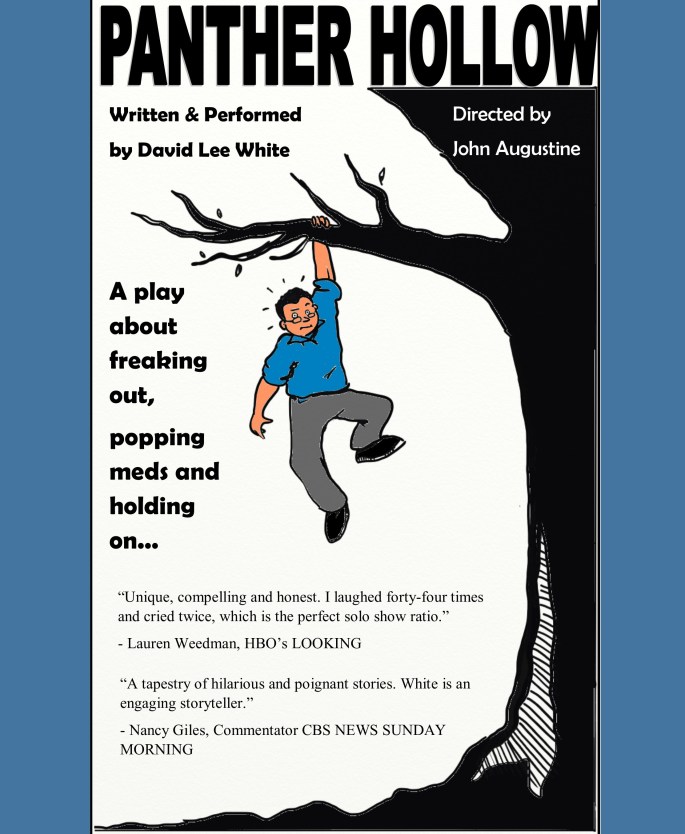
Category: Uncategorized
I’m not sure I’m going to post this joke.
So I wrote a joke this morning. Actually, I “thought of” a joke. “Wrote” makes it sound like I sat a desk. Like I take joke writing so seriously that I clock in to do it. In reality, I was in this half-awake, half-asleep state when I thought of the joke and I thought it was hilarious. But now…I just don’t know.
I wanted to post the joke on Facebook this morning but I stopped myself because, you know, what if it’s not funny? And the more I think about it, the more I’m absolutely sure it’s not funny. I mean, part of me thinks it’s brilliant in the way it taps into modern day annoyances and draws on our collective childhood nostalgia. But then another part of me thinks that it’s not quite obvious enough. It relies on the listener making a connection and I’m not entirely sure he/she will make that leap.
Then again, it’s a joke that came from real life. I was grocery shopping and I had to text my wife and this irritating thing happened and I’m sure it’s something everyone can relate to. So why aren’t I more confident about this? I make jokes all the time. It’s a consistent irritant to my friends and family. What’s one more failed joke? I’m forty-seven years old and I have wisdom that comes with middle-age and the ability to not give a shit what anyone thinks. But at the same time, I know when I’m on Facebook and I read a joke that doesn’t quite work, I think to myself “Poor guy. If only he had phrased it differently, it might have worked.”
That’s another thing. I’ve been perseverating about this joke and trying to rephrase it in my mind. It’s a lot of information to cram into a single joke and if one word is in the wrong place, the joke will land flat. So far, I’ve come up with three different ways to tell the joke and I’m not sure what the best way is yet. It’s highly possible there is no best way. In fact, the more I think about it…this is a really bad joke.
So why do I care if people think it’s funny or not? This is what artists do, right? They put stuff out there and if it fails, it fails. What’s important is that we’re always taking risks. But this goes back to regret – regret that I didn’t invest in comedy more in my 20s, for one thing. Why didn’t I take classes at Second City? I mean I was right there in Chicago when Tina Fey and Adam McKay were there. Why did I have to feel like I was a “serious actor?”
And lets face it, the older you get, the less inclined people are to think you’re funny. You’re viewed as being out of touch or, worse yet, “corny.” I just don’t want to be one of those guys yukkin’ it up at age sixty and get laughs out of pity.
But you know what? Screw it. I’m going to write down the joke and let the chips fall where they may. This is about risk. This is about confidence. Success and failure are illusions. This is about life. Here is the joke:
Wile E. Coyote stopped sending text messages because everyone thought he was constantly complaining about his acne. #fuckautocorrect.
Panther Hollow in da ‘burgh
Bringing Light to Dark Places- Pitt alumnus David Lee White on his new one-person play “Panther Hollow”
In a recent conversation with alumnus David Lee White he explained that theatre has “always been what I’ve done. It’s my medium, it’s the language I speak… the only way I’ve ever really seriously interacted with the world.”
White began studying at the University of Pittsburgh as an acting MFA in 1991. Since then, White’s theatre experiences have multiplied along with his talents, expanding to include director and playwright. Among White’s early experiences playwriting were the “great” classes of Pitt’s Dr. Kathleen George, and a staging of an original piece by the school. He is now the Associate Artistic Director and Resident Playwright at Passage Theatre in Trenton, New Jersey. White’s most recent endeavor, the one-man show Panther Hollow, is the newest fruit of White’s lifelong labor and passion for theatre, as well as a deeply personal return to the landscapes of Pittsburgh.
White recently brought Panther Hollow to our city for a performance at the Arcade Comedy Theatre, and is currently in talks with Pitt about an upcoming, on-campus production, the details of which we will be excited to announce.
Panther Hollow is directed by John Augustine and confronts, in comedic and confessional fashion, the darkest point in White’s struggles with clinical depression. He summarizes the potent concept of his play- “Back in 1995, I had just finished grad school and was still living in this run down house in Panther Hollow. One morning, I found a dead body hanging from a tree down the street from my house. I spent the next year cruising therapists, popping meds and trying to piece my broken life back together. When I turned forty-five, I stumbled across my twenty-year old journal and starting piecing the story back together. This show is the result.”
And this result, believe it or not, is hilarious as well as moving. “I’m unable to avoid comedy,” White said, and he does indeed demonstrate excellent humor in discussing even the most difficult of times. Bringing forward the comedy that surrounds serious issues can be “breathtaking” for White, who cited the work of John Guare and Christopher Durang as examples. White accomplishes this same juxtaposition in revisiting the most “internally intense year” of his life with openness and a readiness to make people laugh.
This is not to say the writing process was easy- White says he struggled with how to honestly approach these experiences, how not to judge such loaded subjects or himself. He also wrestled with how to portray that period in a dramatic way because “depression is really kind of boring.” Eventually, enthusiastic audiences convinced him that this is a story they wanted to see told and subjects they wanted confronted. They were drawn in by White and his journey as well as the intriguing atmosphere of Pittsburgh, which developed into an important component of the play. Asked to describe Pittsburgh in three words, White went with “nostalgic,” “confusing,” and “ever-changing”- an intriguing setting indeed!
Despite the highly autobiographical content of his play, White’s vision is large- the motivation for telling his own story comes in part from his long-time mental health advocacy. White described how the play is a way of sharing information about the deep and unique structures of depression and illuminating ways of emerging out of it- for those who may suffer, and loved ones who struggle to help them. More basically, it is a means of creating communication and openness about illnesses and even treatments still shrouded in mystery and, too often, stigma.
Through the process of developing the play and facing its challenges, it became “liberating” for the playwright and audiences. White explained, “staging the worst year of your life, and having people laugh at it… to put this out there and share this with other people who’ve experienced this” is a way “to say, ‘Let’s not be embarrassed by it.’” By “it” White does mean depression and mental illness, but he also means any experience that causes people to feel isolated and embarrassed. White’s speaking honestly about difficult and lonely times, the sort that had once ashamed him but in fact help define us all, becomes a way for audiences to regain compassion for themselves and openness towards others. This simple but very important transformation of perspective and emotion is just that sort that theatre is able to create, and a testament to White’s multi-faceted commitment to the form.
Asked to advise young artists less far along on their paths, White offered “don’t wait.” “Don’t worry about whether or not it’s going to make you famous,” he said, “do what you want do as soon as possible. Right away.” It’s a good lesson from someone who has not stopped exploring and discovering his creativity and himself, and who has strengthened and contributed to communities in the process of hard work, honest bravery, and an eye for the humor to be found just about anywhere.
Praise for Panther Hollow:
“Unique, compelling and honest. I laughed forty-four times and cried twice, which is the perfect solo show ratio. Panther Hollow is a personal story of imperfect humanity, perfectly told.” – Lauren Weedman, HBO’s Looking.
“A tapestry of hilarious and poignant stories. White is an engaging storyteller who’s expressive and fun to watch.” – Nancy Giles, Commentator, CBS News Sunday Morning.
David Lee White is a New Jersey based playwright and educator who has worked with Passage Theatre, McCarter Theatre, Dreamcatcher Rep, PlayPenn, Rider University and Drexel University. He was recently commissioned by the New Jersey Performing Arts Center and Passage Theatre to create the play Sanism, which will premiere in 2017. His play Blood: A Comedy was produced at Passage Theatre (2009) and Dreamcatcher Rep (2012). His play Slippery As Sin also received its world premiere at Passage in 2011.
Sanism and Bending the Map – Part I
BENDING THE MAP
For the past few years I’ve been working on my one-person, autobiographical show “Panther Hollow,” which talks about my struggles with clinical depression back when I was 25. When I first started researching stories of mental illness – before I decided to write about my own – I began interviewing friends and acquaintances and collecting their stories about depression, bi-polar disorder, schizophrenia as well as stories about the difficulties of navigating the health care system and how our collective, fundamental misunderstanding of mental illness is making us…well…crazy.
Last year, I received a commission from Passage Theatre and the New Jersey Performing Arts Center to turn this material into another theatre piece. Under the working title “Sanism,” I’ve continued to interview people and gather their stories. I’m now at a point where I have so many stories – so many moving, remarkable, even heroic stories – that I’m unable to decide which ones to tell.
Hence, this blog.
Once a week, I’ll be sharing these stories and talking about my research. I’d love to know what you think – what speaks to you, what fascinates you and what pisses you off. By April, “Sanism” will have a public reading at NJPAC. That will be followed by a full production at Passage next season.
So where to start?
Recently, my wife told me about this concept called “Bending the Map.” Bending the map is something that people engage in when they are lost, or confused or in the middle of an experience they don’t understand. It doesn’t have to be depression or a psychotic break or anything like that. Everyone does it. It takes place when the person who is lost realizes that the map their using no longer corresponds with their environment. But instead of trying to understand how to survive their new environment, they decide there must be something wrong with the map. So they bend it. They break the rules outlined in the map in order to force it make sense with their surroundings. Of course, this can’t be done.
While it sounds like something only mentally ill people would engage in, all of us do it to some degree all the time. Unfortunately, we also bend the map when it comes to dealing with the mentally ill. When we can’t understand someone’s behavior, we prescribe motivations and character traits to them that we *can* understand. That person sitting in the corner sobbing for no reason? That doesn’t make any sense. They must just want attention.
We don’t understand mental illness because we don’t listen to the stories of the people who suffer from it. And we don’t listen to the stories because understanding them means creating a new map – one that clashes with our societal and cultural biases.
I want to make a new map. I’m starting with the stories.
My friend Gene (not his real name) was in his mid-30s when he woke up one morning, left his wife and four year old daughter, got into his car and started driving. He was missing for over a week. His friends and the police were notified. His wallet was found in an alley in Chicago, hundreds of miles from his home. He finally turned up in a hospital and returned home, but spent the next year coping with bipolar disorder and the dissolution of his marriage. Here’s what he told me during our interview two years ago. Highly intelligent, eloquent and introspective, Gene is able to look back on his bout with mental illness with an insight that is quite unique. I should also mention that Gene is funny – very funny – so if you wind up laughing at some of things he says, he meant for you to do that.
GENE
I didn’t have a map. I didn’t have anything. I just followed the signs. I knew…”go to the interstate and turn left. That way is Chicago.” But I wasn’t scared. I had no doubt, no fear, nothing like that.There was nothing really that led up to it. At all I wasn’t having any problems in my marriage – I mean we fought and stuff but there was nothing…we hadn’t been talking about divorce…there were no real stressers. The day before, I was working at the comic book store and a kid and his grandmother were checking out. They paid their money and I just stared at the receipt and I couldn’t do the math. I just couldn’t figure it out. Then they started talking to me but I couldn’t understand what they were saying and I became convinced that they were speaking to me in code. It’s such a cliché, the whole “I’m being tracked by government agents” thing. But that’s what I thought. It’s so typical.
That night, when Ally was asleep. I picked her up, handed her to Janet and said “I need you to take care of her.” Then I went to bed. The next morning, I got up, got dressed, got in my car and headed to Chicago. Because I had to see Del Close.
Del Close, of course, wasn’t in Chicago. Also he was dead. But there was a really, deep subconscious thing going on. Obviously, I knew him because he was an improv teacher and I did improv. But even more important than that, I knew Del Close because Del Close wrote a surreal comic book called “The Wasteland” and I had that in my head. You have to find this book and read it. You have to. It’s just a big “fuck you” to our whole notion of reality. So I subconsciously knew about the wasteland and it was written by Del Close and I knew Del Close was in Chicago so I had to go to Chicago.
It took me two days to get to Chicago. There are a couple of things I remember. I stopped once at a rest stop that had this circular dining area. I started walking around the perimeter of it because I suddenly understood that this was the whole world and I needed to encircle the world. And I knew it was the world because in the middle of the dining area, sitting at one of the tables, was this old guy playing a game of chess with a Hassidic Jew. I understood that was a symbol. A sign. Everything was a symbol. Everything was a sign. That was the level I was operating on.
About two hours outside of Chicago, I stopped at a hotel. I don’t remember what I did there. I think I just walked in, fell asleep, then got up the next morning and left. But I remember that I made sure I left the room exactly as I found it. That was important for some reason. I was covering my tracks.
When I got to Chicago I spent a lot of time walking. For three days. I didn’t sleep. I just walked. On the first day, I ditched my wallet. Because I had it in my head that people were trying to find me so if they found me, I didn’t want to have any ID on me. I didn’t want anyone to know who I was. So I threw my wallet in a dumpster in an alley.
At some point I went to this bookstore. And the reason I went there was because somehow I knew that Dave Chappelle was there. That was really important because Dave Chapelle was going to be my guide. My mentor. You see at this point, I realized that Chicago was a game. A puzzle. And I was playing the game. My job was to walk through Chicago, find the clues and solve the puzzle. And once I did, once I won the game, I would be…king of the world, basically. I would know everything. I would control everything from the background. Make policies. Pass laws. I would be in control. But first I had to solve the puzzle. I had to win the game.
To be continued…
Nick Sings Hamilton
Happy New Year
Panther Hollow in 2016
Here’s an update on performances of Panther Hollow in 2016. For more info, email me at david@passagetheatre.org
JAN
Friday, Jan 15th – Arcade Comedy Theatre, Pittsburgh, PA 8:00
Saturday, Jan 16th – Point Park College, Pittsburgh, PA 7:00
FEB
Rider University – Private performance, date & time TBD
MARCH
March 4th – Passage Theatre, Trenton, NJ 8:00 PM
March 18th – Passage Theatre, Trenton, NJ 8:00 PM
Third show TBD
THINGS I LEARNED AFTER TELLING GUN OWNERS TO GO FUCK THEMSELVES ON FACEBOOK.
.
A few minutes after I read about the shootings in San Bernardino, I rage-posted on Facebook. The post read – “Fuck this and fuck everyone who makes me afraid for the country my child has to grow up in. Take away the fucking guns. Sorry, responsible gun owners. I don’t trust that there are enough of you to worry about. Your feelings will get hurt but you know what? You’ll live.”
Good idea, right? ??
My profile is completely public. Everyone can see and share and comment on everything. Until recently, I’ve liked it that way. I make my living in the theatre and I like to know that complete strangers can learn more about me and my work. Yes, yes, I know that’s what a website is for. I have one of those too.
Quite frankly, I know better than to post something so reactionary about a politically charged topic. I like to think of myself as one of those truly enlightened individuals who can see all sides of an issue. I’m a playwright, for crying out loud. I work with other playwrights. If we don’t figure out a way to have empathy for people we disagree with, we aren’t doing our job.
But this was my tipping point. I was pissed. Another mass shooting? Are you kidding me? And while I know every mass shooting is contextually different, they all have one thing in common. The shooters all have guns. That’s why we call them shooters. Duh. They all somehow procured guns and they shouldn’t have been able to. So in that moment, in my fit of Facebook indignation pique, I posted something harsh about responsible gun owners. Now, in my mind I put the word “responsible” in sarcastic quotes. I know there are genuinely responsible gun owners out there. But I’m not all that concerned about them. However, I am concerned about the people with armaments up to their ears that assert their responsibility so often that I start to think…”methinks the lady doth protest…”
Twenty minutes later I was on my way to teach playwright to a group of high school students when I checked Facebook on my phone and saw that my post had almost 800 likes.
Uh-oh.
A few hours later I was playing Star Wars with my son and I looked at my phone. The post had been shared over 200 times.
Yikes.
I might have deleted the post right then and there if my son hadn’t told me to stop staring at my phone while he was hitting me with his light saber.
Later that night, of course, I was doomed. The post was everywhere, it seemed. It hadn’t really gone viral. More like viralesque. Strangers were posting on my page calling me an idiot and a moron. One guy called me a chickenshit and a little girl, then told me to go eat a bag of dicks, which seemed extreme (Jesus, a whole bag???). Then there were the slightly less personally offensive posts that tried to take in the big picture and explain to me, in their passive-aggressive way, that the problem was far more complicated than mere access to guns. One had to take into account mental illness, bullying, workplace violence, terrorism, etc., etc.,
Of course I knew that. The whole hyper-intellectual, holier than thou approach is usually my bag, which is how I recognized it. But this time was different. I was pissed. I posted in anger. And while people that knew me understood my post within the context of my entire persona (at least my Facebook persona) these strangers had not. At that point, my post had been read by more strangers than friends. The only thing they knew about me was that I didn’t care about gun owners and their rights.
Honestly, I guess I really don’t care. I understand that gun owners have rights. But I don’t understand the need for those rights. And I really don’t understand the extreme, almost spiritual devotion to those rights. I don’t understand the person whose identity is wrapped up, inextricably linked, to their possession of a fire arm.
I understand hunters. My grandfather was a hunter. He had three guns in the house. One was a pellet gun but I still count it because I almost put my eye out with that thing. Then there was the rifle mounted on the fireplace mantel, held up by two horse spurs. The scary one was the hand gun in his underwear drawer. I don’t know if it was loaded. As a kid, I would occasionally open the drawer when no one was around and just look at it. I held it in my hands exactly once and never again. My grandfather bought the gun after an intruder broke into his house, bashed him on the head and tied him to a chair. My father was sixteen at the time. He came home to find my grandfather trying to maneuver his way down a flight of stairs while still tied to the chair. My grandfather’s gun was for protection. He never used it. As far as I know, it never left the underwear drawer except for the one time I held it in my hands.
But I still don’t get it. Why do some people need so many guns and why are they afraid of people taking them away? I try to find some equivalency in my own personality. For instance, I love books. What if someone tried to take my books away? Nope. Doesn’t work. Books don’t kill people. Not even those Twilight books everyone seems to go on and on about. I also love my decongestants. Honestly, if I didn’t have my decongestants I don’t know what I’d do. But I accept the fact that I have to show my license every time I buy a box and I can’t buy more than one box a day just in case I’m some guy that makes meth-crack in my basement or whatever freaky thing people do with decongestants.
But guns? I don’t understand. My empathy fails me. I accept them as a reality, of course. But I don’t understand the passion or the fear of losing the right to have a gun. I mean, I don’t honestly think that all gun owners are trying to kill people. Please. That would be ridiculous. But if we could make a dent in this mass shooting problem by making it a little harder to get a gun, shouldn’t we do that? What’s the problem?
There’s this secret part of your Facebook message box that I keep forgetting about. It’s for all the messages from people who aren’t actually your friends. Thursday morning I realized I had a couple dozen in there. Hoo-boy.
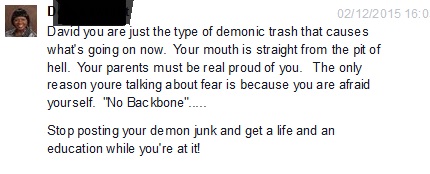
As one of my friends posted in a comment “Why is No Backbone in quotes? Is this a recipe?”

And this…

And so on…
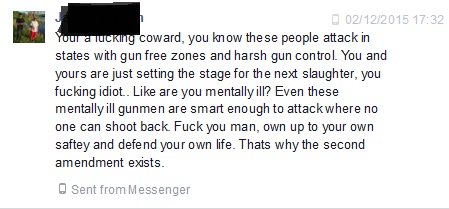
And so on…
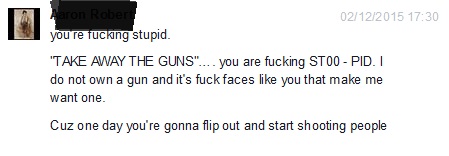
And so on…

And so on…
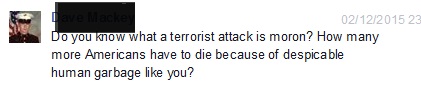
Ad infinitum…
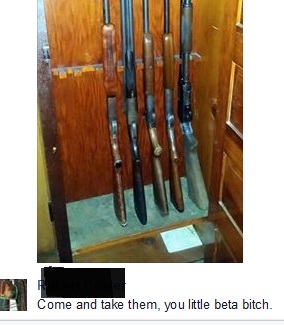
It’s pretty much an accepted truth of humanity that we very seldom change our minds about anything, particularly when we perceive we’re being attacked. In fact, we double-down and embed ourselves even further into our point of view even if we’re contradicted by irrefutable data. I’ve never really had that problem. Not because I’m so enlightened, but because I think I’m always in the wrong. Several of those messages I received are totally true. I am a big pussy. So I tend to step back and be the guy that listens, tries to see every point of view and bring everyone to a consensus, even if it means sacrificing my own convictions.
But that hasn’t been working when it comes to gun control. For anyone. We talk and talk and talk and people get shot and shot and shot. So I got pissed. I posted on Facebook while pissed. I made people angry. And they reacted in anger. But instead of feeling upset that I had been attacked, I realized that it wasn’t the end of the world. It was a bit like the first time you get a bad theatre review. It sucked, but I survived. People keep asking me if I was able to sleep last night. I slept fine. I’m not a victim. I’m not one of the people that was shot.
Now that I know I can speak out of anger, gain support from my friends and survive the onslaught of negative reactions, I’m much more willing to speak out in anger the next time an opportunity rolls around. If we can’t change things through rational discussion, maybe we can change things through irrational anger.
So you tell me – did I just become part of the solution or part of the problem?
Or am I kidding myself because neither rational debate or irrational anger makes a bit of difference? Perhaps I’m just as powerless as I was yesterday.
Some kind words from writer Scott Sickles about Panther Hollow…
“As profound as it is funny, David Lee White’s PANTHER HOLLOW is an intimately personal tale that should be experienced by everybody. An account of the playwright/performer’s first salvos in his battle against clinical depression, the piece sheds light on a condition people still seem to think happens in a vacuum. Even Mr. White’s younger self wonders why he feels down in the dumps “for no reason.” But there is a reason. “You have an illness.” It’s a very thorough illness, too. At best, one becomes doubtful, anxious, and mopey. At worst, one finds oneself with a rope around one’s neck or staring down from a bridge into the abyss. Again, there is a reason: your brain is essentially trying to kill you.
“But this is no medical travelog. White takes us back in time to early 1990’s college life in Pittsburgh. You can practically see, feel and smell his old neighborhood as he describes the awkward, uncertain, hilarious, grisly, and emotionally (and physically) naked events on his quest to find health, happiness, and even love. We get a mind’s-eye view into his dreams, anxieties, and youthfully questionable decision making process. There are even a few moments where we the audience wince with regret at decisions he’s about to make 20 years ago. It’s these moments among others that imbue the darkness of the subject and story with much, much laughter.
“As a performer, Mr. White commands the stage with the same energy, wit, ease and charm that he had when he was actually in his early twenties. PANTHER HOLLOW feels like an entry in your best friend’s diary that you weren’t supposed to read, but now that you have, you need to share it with another friend whose life literally depends on hearing it. The lessons it teaches are crucial for anyone who has experienced or knows someone who has undergone this struggle. It’s also entertaining as all get out!” – Scott Sickles, Writers Guild Award winner and three-time Emmy Award nominee
John Augustine – the director of PANTHER HOLLOW – has a barn.
It’s true. I’ve seen the barn. It’s next to his house. Also, at one point I heard an old-timey phone ring while we were standing outside and I’m pretty sure he said “That’s the outdoor phone. Because there used to be sheep here.”

More importantly, John is directing Panther Hollow and he’s incredibly funny and has helped me hone the script and give the piece shape that it wouldn’t have otherwise. I am incredibly in his debt and I realized today that I’ve barely mentioned him at all. I think I thought to myself “Oh, this is a guy with a show off-Broadway right now. Also he wrote for TV and has lots of plays and stuff. Surely my little skit isn’t all that important.” My mistake. He’s done an incredible amount of work making sure that I don’t humiliate myself next week. Anyway, here’s to John Augustine. His bio is below. Proud and a wee bit humbled to have him on my side. Also, here’s a link to the show he directed “The Hummingbird Tour” which is running through November 22nd. http://www.hummingbirdoffbroadway.com/

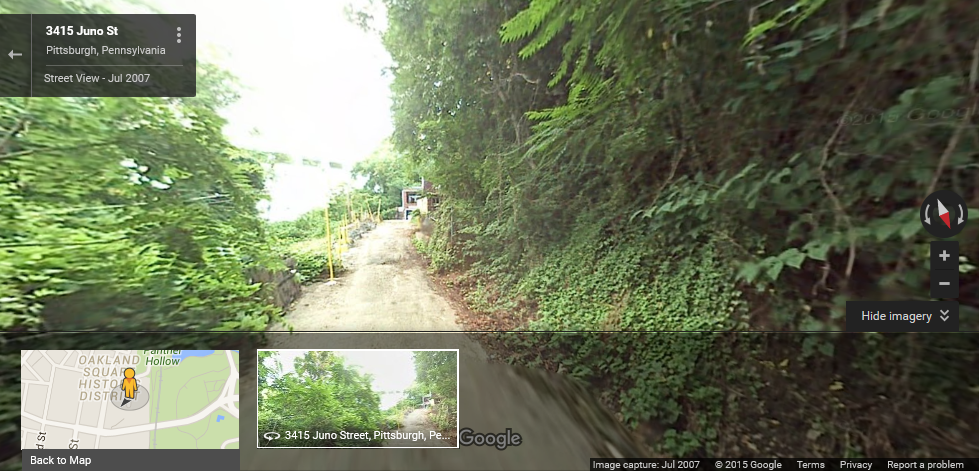
Even the google street view truck was too scared to get close to my old house #pantherhollow
 David Lee White